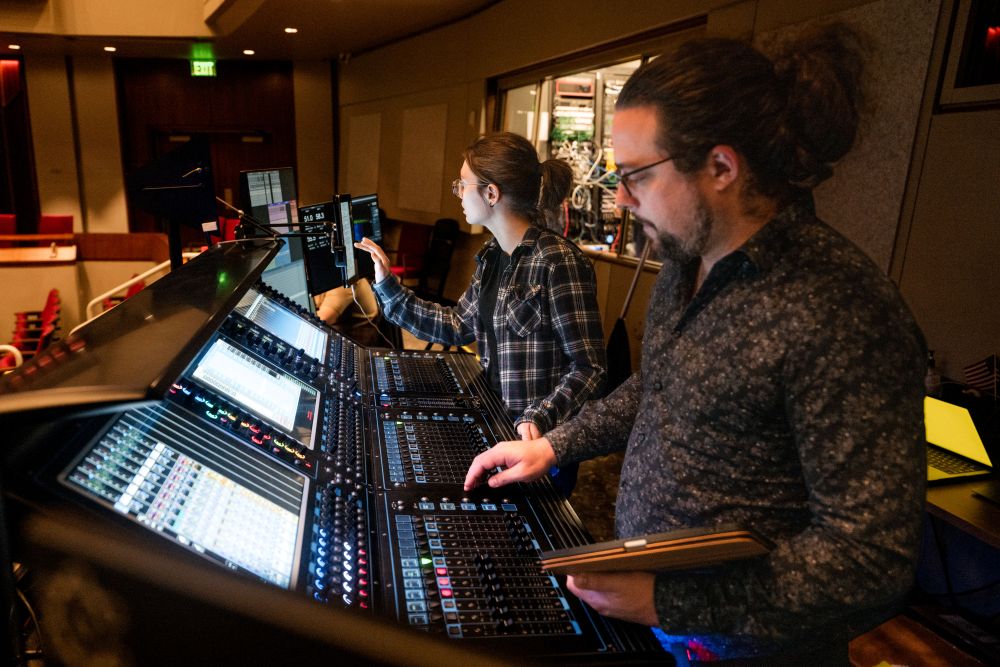
Members of the production team at work on “The Wizard of Oz” at the Byers Theatre in Sandy Springs, Georgia.
Design for production at 1,070-seat Byers Theatre in Sandy Springs relied on Dante-enabled TiMax SoundHub, TiMax TrackerD4 tracking, and a Dante network backbone to connect microphones, consoles, processors, and amplifiers.
A recent production of “The Wizard of Oz” by the City Springs Theatre Company at the 1,070-seat Byers Theatre in Sandy Springs, Georgia was supported by a spatial sound design relying on a Audinate Dante-enabled TiMax SoundHub, TiMax TrackerD4 tracking, and a Dante network backbone to connect microphones, consoles, processors, and amplifiers.
Anthony Narciso brings extensive professional experience to his work as a lead sound designer, including his work in theater as a member of United Scenic Artists, Local USA 829, IATSE union, and as a board member of the Theatrical Sound Designers and Composers Association. For “The Wizard of Oz,” he says he approached the production “as if we were doing a tour,” given the lack of permanent infrastructure, creating a fully deployable sound system that transformed the static venue into an immersive, story-driven soundscape.
“We deploy a spatial audio system and tracking for the spatial audio system that allows voices to be placed in time and space,” Narciso explains. The large cast, including a child ensemble, demanded precision and clarity across a complex mix of dialogue, music, and effects.
Producing “The Wizard of Oz” posed both artistic and logistical challenges. The load-in period was just over a week, half the normal time. “We normally have about 12 to 14 days to get up a show, and we have about a week to put this up,” Narciso notes.
From a creative standpoint, the show demanded sonic storytelling that could balance an orchestra, environmental effects, and vocal clarity. Narciso: “The biggest thing for me is providing clarity to cacophonous moments.” During the tornado sequence, for instance, “we have to be swallowed by this tornado… but we also have to hear the orchestrations clearly.”
The sound design hinged on a TiMax-based spatial audio system. The TiMax SoundHub processor and D4 tracking system create delay-based spatialization, placing each performer’s voice in its physical onstage location with accuracy. “Without Dante, this is not even a conversation,” Narciso says. “You need an individual channel for each speaker cabinet… Dante’s the way to go to do spatialized audio.”
The complete signal chain included:
- Shure Axient wireless microphones feeding a DiGiCo console via Dante
- Each microphone sent over Dante to TiMax SoundHub (up to 64 inputs and 38 outputs used)
- DiGiCo Orange Boxes convert Dante to AES3 to feed 17 amplifiers driving 65 loudspeakers
- QLab playback systems running Dante Virtual Soundcard for primary and backup operation
- Wavetool monitoring software leveraging Dante splits for real-time RF and audio analysis
- Clear-Com Arcadia intercom integrated with Dante for crew communication and spotlight monitoring
- Wavetool routes through a Clear-Com Arcardia channel via Dante to key in on specific microphone issues while roaming
- Backstage paging and lobby feeds are distributed across dedicated Dante channels
The Dante infrastructure also enabled virtual soundcheck capability — recording live inputs directly into a laptop and routing them back through the console for mix rehearsal. “If the cast isn’t in for 30 minutes, we can hit the button, play back the show audio, and the A1 can be mixing. It’s invaluable.
“It sounds better than some Broadway shows,” one lighting designer stated. Others noted that they “understood more of the words in your shows there than I do in a Broadway show generally.”
In the company’s earlier years, sound was the area that needed the most improvement. Amongst several other improvements, implementing the spatial system led to the audio receiving frequent compliments from longtime patrons as well as new audience members. This feedback highlighted the importance of spatially accurate sound placement, something Dante-enabled networks make seamless.
Narciso concludes, “The best thing I can tell you is Dante just works.”
Click here for original article.