Categories
Linea Research Martin Audio Optimal Audio TiMax

THE RITE STUFF

The below article, written by Phil Ward, was published in LSi and details the development of Martin Audio and fellow Focusrite Group brands TiMaxOptimal AudioLinea Research and OutBoard.

(A PDF of the original article may be viewed here).

“I’m delighted to be back in the live sound business,” says Focusrite chairman Phil Dudderidge. “It’s where I started.” Such a full circle began with time on the road with Led Zeppelin and others, followed by the establishment of Soundcraft as one of the world’s great live sound mixing console brands. It reaches this fulfilment because Dudderidge’s current enterprise has created a portfolio that now includes Martin Audio, Linea Research, TiMax and panLab, and the live sound business has a new array of challengers for its top prizes.

The name of that current group is Focusrite plc, as floated on the London AIM market almost 10 years ago. It’s one of pro audio’s finest marques, with roots involving names like Rupert Neve and George Martin and some of the best recording studios in the world. But maybe the real focus now is not on the frequency curve, via Neve-inspired equalisation, but on people. The Focusrite mix is as much human as it is sonic, as the story of the latest additions reveals . . .

GROUP DYNAMIC

After over three decades of navigating the bewildering recording market, adding new modules and new acquisitions into a portfolio that somehow captures every angle of entry into perhaps the most fluid music business sector of all, Focusrite flipped. A new trajectory into sound reinforcement was launched, beginning with the acquisition of Martin Audio. After this gear-change, subsequent purchases have fallen into place and made perfect sense. But, at the time, Martin Audio was a revolution.

That was in December 2019, followed 16 months later by the launch of a new brand, Optimal Audio, designed to shake up the world of commercial audio installation. In March 2022, Focusrite acquired amplification market leader Linea Research and then, in quick succession, there was a pincer movement into spatial audio: Out Board, the home of TiMax, was bought at the end of last year; and, just three months ago, Innovate Audio, the home of panLab. These two companies occupy distant but highly complementary corners of this market and, as their founders confirm, dovetail their own plans into those of Martin Audio and Linea Research with uncanny opportunity.

There have been many manufacturing groups before. This time, say all the leaders of this one, it’s different. One question keeps coming up: how do you provide the protection and support of a group while nurturing the independence of each brand – and not just the brand, but each company, and the people within it? You can keep all the different logos, but to avoid that being purely cosmetic, how does the spirit of each business survive in a round table?

Phil Dudderidge begins. “We are the Focusrite Group, and we are different,” he says. “Our culture has evolved over 35 years, at least in my time, and we expand beyond our origins in studio products into broaderbased pro audio activities. There’s a lot of technology that crosses over now, and I don’t see that a live sound company doesn’t belong in the same family as a recording products company.”

This is the first focal point, if you will. The modern stage is edging more and more towards a studio-like environment and can accommodate products and techniques hitherto associated with recording or broadcast: high-quality mic-pres; condenser microphones; digital plug-ins; highly sensitive and personalised monitoring; click tracks . . . and so on. The only real difference is the acoustic environment you’re working in, so the synergies across the Focusrite Group begin to stretch further than might first appear.

Dom Harter, who is Martin Audio’s MD, defines it more closely. “As Martin Audio joined the group,” he recounts, “we spent quite a lot of time planning how the meld would take shape. Myself, Phil, Tim Carroll [Focusrite CEO] . . . we all start from the position that customers care about brands, and we have to protect the things about the brands that they value: engineering; customer-facing staff; support and so on. And in a strong group, these things can be better protected than they would be on their own: the backroom stuff, like warehousing, finance . . . the resources that power a brand. They all get a better service.”

One syndrome that exercises Harter is the one that tries to supercharge an already successful brand by turning it into something that its customers fail to recognise. In fact, many of the key figures in this expanding group have similar tales to share about becoming disillusioned within very large organisations that may, or may not, have achieved this, giving the Focusrite challenge a special edge: the mission of renegades, maybe, anxious not to become the counterrevolutionaries that repeat the cycle.

The special relationship between a brand and its customers is one of professional audio’s greatest achievements. MI has it too, to some extent, and it is noticeable how business leadership gets this wrong if it’s not careful. Music and audio users have an emotional connection to the products they need to buy, and, quite frankly, it’s hard to understand it if you’ve never felt it. They certainly don’t teach it at Harvard Business School.

But there are differences between pro audio and MI, according to Harter – mainly to do with the end user and whether they buy something with which to make music or a ticket to watch it. “But that just means,” he says, “that we have to make sure we’re focused on the right sales solution for what we’re trying to address: we call it either Content Creation or Audio Reproduction, and the market strategies are different. If you tried to fuse them into one, you’d let both sets of customers down.

“It has to come from the top, to be built into the structure, that our organisation will be focused on our customers and receptive to them, and that has to reach all the way back into engineering. We can’t allow the people making the technology at a workstation to become cut off from the outside world.”

There’s a lot of technology that crosses over now, and I don’t see that a live sound company doesn’t belong in the same family as a recording products company . . .
Phil Dudderidge

“Martin Audio has enormous growth potential,” continues Dudderidge. “The market it serves is massive globally, and the greatest opportunities are perhaps outside this country. Other parts of the group already have huge market shares and will grow relative to that market – Focusrite itself being a good example with audio interfaces. You can try to grow by doing other things, but run the risk of losing sight of your core business. Focusrite is the audio interface company, which is something I recognised around 2005-2006. We made a strategic decision to do this, and by making that decision it happened. So, different sections of the business will deal with growth challenges in different ways.”

Adding TiMax to the group will help both TiMax and Martin Audio, and adding panLab will help TiMax. But each is independent: TiMax, for example, is still available for use with other branded loudspeakers, and the relationship with Focusrite is being carefully designed to allow this to continue and prosper. “There are many brands in the group,” says Harter, “some are large, some are small, and the trick is to make sure we help each brand in its own evolution, whatever point it’s at, rather than swallowing any one of them into some monolithic entity.”

UPGRADE PATHS

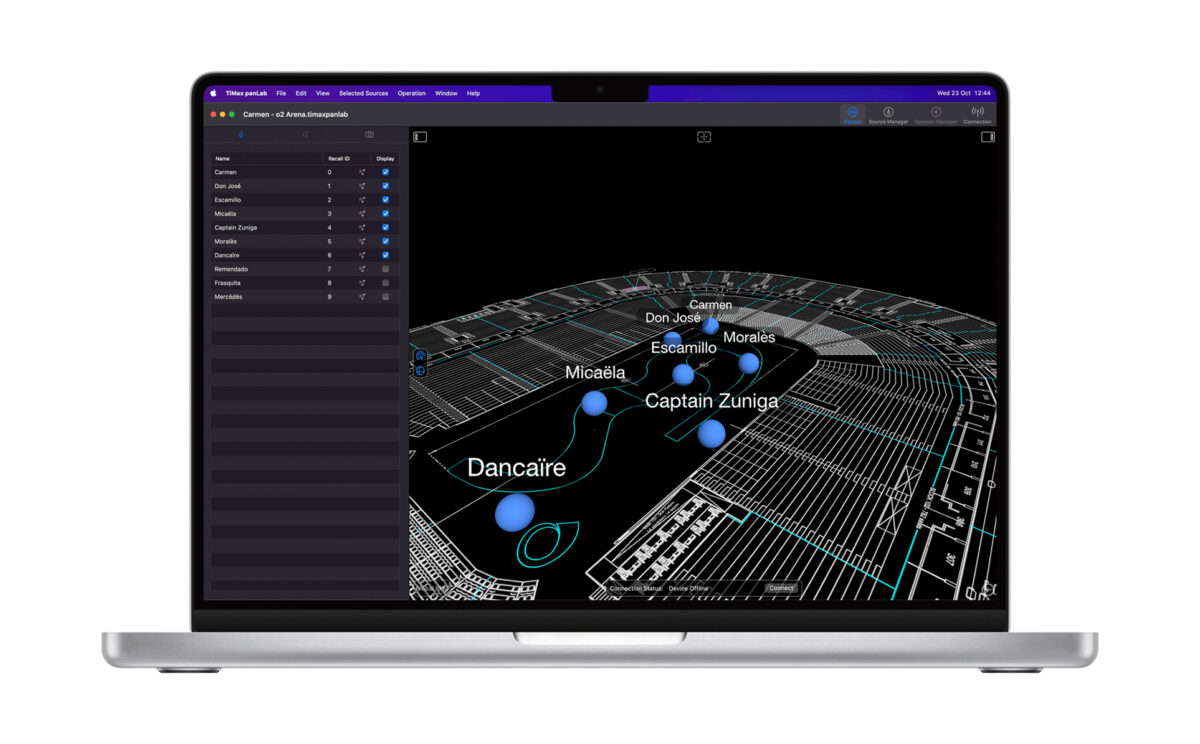
Perhaps it’s the sheer number of aspiring producers, of one kind or another, that use Focusrite interfaces, but the group has become highly sensitive to newgeneration customers who will shape tomorrow’s industry. Early on, Martin Audio adopted strategies to introduce younger users to its products and take them on a journey towards the high end. Now, panLab seems poised to do the same for TiMax, offering a point of entry to spatial audio that may well begin with solutions based on Optimal Audio speakers and end with Tosca at the Royal Opera House.

Getting these customers from the nursery slopes to the Hahnenkamm Streif Downhill is very high on Harter’s agenda, his own son already on a path towards high-end mixing but with no credible path towards spatial audio for someone of his age. “TiMax was a no-brainer,” he says, recalling time at BSS with Dave Haydon. “But it’s not a cheap endeavour, even though it gets amazing results with relatively few loudspeakers. Talking with Dan Higgott – and, firstly, realising just how many thousands of users he’s got! – we realised how we might be able to start building this journey into spatial audio as we’ve done with Martin Audio and the journey towards large-scale PA. We can get people into this concept early on.”

While protecting the loyalty customers feel towards each brand, the Focusrite Group nevertheless has what are now ‘sister’ companies and doors are open. “There’s lots of R&D collaboration, sometimes informally,” Harter says, “and it’s more successful here than I’ve ever seen anywhere else – I think that’s because everybody knows they’re doing it for their own brand. Even if Linea people are working with Martin Audio people, there’s an invoice from one company to another and everyone benefits. As long as we understand every customer and what they want, whatever happens will be for the right reason. Any of our technology is welcome in any market, if it fits.”

“I see them as symbiotic profit centres,” adds Dudderidge. “Each one is identifiable, but they can all be supportive of each other while having their own primary goals.”

At the high end, the combination of TiMax and Martin Audio’s Multi-cellular Loudspeaker Array (MLA) is a huge, mouthwatering, number-crunching prospect, connecting audience and stage in a cat’s cradle of dispersion and reflection. But there is intentionally no ‘group’ R&D structure, according to Harter. “We did not want a hermetically sealed think-tank,” he says. “What we want is for everyone to carry on where they are and be able to reach out and share when they need to. If you are not able to look at the whole system, you are fundamentally limited by your corner of that system. Ambrose Thompson, one of Martin Audio’s key researchers and the lynchpin of MLA, has immediately begun to look at things in a whole new light. Within about five minutes of a conversation with Robin [Whittaker, co-founder of TiMax], new directions were apparent.”

All the time as we’re talking, even with such riches in the hold, Harter steadies the ship. “We have to keep within the limits of what people need,” he insists, “rather than persuade them they need something else that we’ve just thought of. Everything must be application-specific, and if the engineers together understand the complete set of boundaries, they will be able to make cleverer products and better solutions.”

Associated with TiMax for so long, Robin Whittaker and Dave Haydon will gradually step back from their leading roles as new recruits step forward: Rik Kirby, who takes over as commercial manager; and Dan Roncoroni, who is now product manager. Dan Higgott, who founded Innovate Audio and launched panLab, also joins the team. Whittaker and Haydon will not disappear overnight, with the umbilical cord still unclamped. But it was time for change.

“There is a responsibility towards the community you create, and we realised that more resources were necessary,” says Haydon. “Various people have approached us, it’s no secret, but we wanted the right people. Dan Roncoroni has been working with us as a designer and consultant for several years, and we’ve known Dan Higgott’s work for a while. Dom and I realised we’d need a commercial manager as well, so when Rik became available it was a perfect fit. These are people with imagination and passion.”

“The association with a world-leading loudspeaker brand was important to us,” adds Whittaker. “Essentially, the sale is driven from the loudspeaker sell, and the DSP follows. To be honest, we were lucky that there was one left that we would be happy to put our name to!”

How do TiMax and panLab complement each other? “It’s all about the customer journey,” explains Higgott. “My background has been trying democratise access to spatial audio, and making it possible for those without the time and budget for the original solutions. That’s Dom’s vision, too: how to get people on board, intuitively, with a whole new way of approaching sound design. Both products are now under the TiMax brand, but creative users can select according to their resources, their experience and their individual aims.

“The two software suites will talk to each other and make it easy to switch between panLab projects and TiMax projects, and people will become familiar with the same user interface. My view is that as many sound engineers as possible should be able to work with spatial audio, whether from within the console or elsewhere, and that ties in perfectly with Focusrite’s vision of inclusivity.”

“We’re quite early on the roadmap,” points out Whittaker, “so it will be a while before we can reveal any specific features. But the workflow will be as familiar as possible for everyone.”

Kirby’s inclusion is highly serendipitous: he decided to return to the UK from the US, where he had many successful years at Renkus-Heinz and with his own distribution company Allied ProTech – which included both Linea Research and Optimal Audio – and found an opportunity waiting. “20 years ago, Robin and I were in Canada doing separate seminars at AES on TiMax and SoundWeb,” he recounts, “and I can almost recite his presentation today, it was that impressive. The psychoacoustics of it really made an impression, so to get this chance to work with TiMax so closely is amazing.”

Most likely, the ‘panLab’ name will remain as a version of TiMax, so the many who have already embarked on the journey will find familiar territory. It’s a good strategy, because it protects the spirit of each product while uniting them in a common goal: that goal being the piecemeal transition of the professional AV industry to spatial audio. Which leaves the question: what is the professional AV industry today?

“I’ve been using spatial audio in various sectors: themed entertainment; theatre; retail – all sorts of applications,”says Roncoroni. “When this role came up, I saw it as a way of getting closer to TiMax – which, objectively, is the best hardware renderer for every use case I’ve seen – and a way of giving something back to Robin and Dave. I was a customer of theirs when I was at Autograph, and since then I’ve been specifying and commissioning TiMax as a freelancer.

“There is a growing understanding of the workflow benefits of using a hardware renderer in theatre and concert sound, but the new markets are in areas where the emergence of Dolby Atmos in streaming services has created at least an awareness of spatial audio. The appetite may be growing broadly, but I would say the traditional pro audio markets are coming to terms with it more sensibly. They don’t need the hype, and TiMax has the most educated user base of all.”

RESEARCH & DEVELOPMENT

Linea Research is now the power, as it were, behind the throne. Ben Ver is engineering director and for him, again, the timing was just right. “The size Linea was before acquisition is a difficult size for companies,” he says. “It’s big enough to do many things a start-up cannot, but not enough to break through the glass ceiling and double, or triple, your turnover. You start to need systems and processes that medium-size companies don’t have. We now have a professional HR team with corporate, legal back-up, and while we managed for 20 years without it, it takes that pressure off. The same is true of IT, which covers everything from my PC being faulty to the integration of GitHub and online registration, for example.

“From an R&D and engineering point of view, I no longer have to deal with any licensing renewals. They deal with it all. We’re in the process of migrating some of our systems over to the Focusrite way, and the group already has preferred software for various things: I can ask what the in-house preference is, and I’m free to use that. But it’s still my choice. I’m not told what I must use.”

The expansion path is particularly visible, to Ver, in the ability to develop new sales channels. “We had a strong reach,” he says, “but now our horizons are bigger. Being part of a group gives you more leverage. We’re also part of a sub-group within Focusrite, and we’ve been able to align much of our distribution with Martin Audio – where it makes sense. But, again, it’s not dictatorial. It’s adaptable to the best needs of both Martin Audio and Linea Research in each case. We are stronger together. The support is the main thing. But we haven’t been bought because we needed fixing, and we feel as creatively autonomous as we did before. It’s the best of both worlds, really.”

It’s also significant that the freedom to pursue OEM deals – very much the foundation of the Linea business – remains, while supporting Martin Audio with engineering and R&D resources. “Also, every single Linea-branded amplifier is sold into systems that use other makes of loudspeaker,” Ver adds. “Linea is expected to grow on all these fronts: Martin-plus Linear loudspeakers; Linea amps; OEMs.”

The Focusrite deal has not cost Linea any OEM customers either, Ver reports. “In such supply-constrained times, you might think some people would worry about Martin Audio being favoured,” he says. “But that hasn’t been the case. Both Dom and we at Linea have been at pains to make sure that no one in the industry has any justification for thinking that. We said we’d be fair, and we have. In fact, we’ve gained one or two significant OEMs since acquisition.”

There may also be less product-bending at Linea than you might assume, given the access to both Martin Audio and TiMax R&D. “We were acquired as the experts in amplification,” Ver says, “and no-one else in the group does it. It’s more the other way round: to compete at the top level, a loudspeaker manufacturer has to own its electronics destiny. OEM is not sufficient. We’ve been supplying Martin Audio on that basis for a while, but it doesn’t get Martin Audio precisely what’s necessary to reach the very top – which was part of the reason for the acquisition. To gain extra footing in this sector, there is now the means to create future loudspeaker platforms that will absolutely go toe-to-toe with anyone. With ourselves, Martin Audio and TiMax, Focusrite has deliberately bought technology leaders. It’s a clear statement of intent.”

As is this, from Ver: “I can imagine an amplification platform ideally suited for use with TiMax appearing on my radar – in the same way that designing power modules for active loudspeakers tailored for Martin Audio’s requirements is already on my radar. That’s the advantage of having Linea in the group.”

Again, these are mutual advantages, not mob rule. There is no roadmap for coercing customers into buying a one-stop solution, simply in order to grab market share. The respect for customer choice rules that each brand must be able to continue its presence on the market as before, competing openly and freely, and not be compromised by any kind of centralised control beyond the choice of paperclips. Similarly, each product management decision must be to the benefit of everyone involved, with solid, applicable reasons for it. An ecosystem will evolve, and deliver its own promises, but it won’t be the only reason to buy from the Focusite Group.

It’s a new era. Beautiful as they were, in the 1980s Focusrite only sold – only made – two Forte consoles ever, at a time when the luxury recording market was in decline. Dudderidge stepped in then, and has continued to steer Focusrite to this point, a point at which the industry is about to recalibrate audio output as never before.

In one sense, sound reinforcement is a tight bottleneck of point source and line array exit points, all that clever processing covering a tiny percentage of air space. The rest of it – every nook, cranny and angle where people walk, breathe and listen – is just waiting to be filled. Rite here, rite now, you could say.

Click here for original article.

Categories
Martin Audio

CHINESE PUBLIC SECURITY BUREAU INSTALLS MARTIN AUDIO

CHINA: Martin Audio speakers have recently been installed in a large conference hall of a Chinese public security bureau. The systems were selected by the bureau to enhance the audio experience during important meetings and events with improved speech clarity, as well as by minimising background noise. The aim was to create an immersive sound environment in which all participants would be able to clearly hear and understand proceedings.

The manufacturer’s TORUS constant curvature line array speakers have been implemented, with a pair of T1215s and a T1230 flown on both sides of the stage as the main speakers. The series features adjustable horizontal coverage which allows the performance of the speakers to differ greatly in terms of tone and coverage efficiency.

Additionally, two double 18-inch PI218 subwoofers from the Martin Audio PI series join forces with four 12-inch PI12 full-range speakers which are used as fill speakers, along with four 12-inch LE100 coaxial monitor speakers at the entrance of the stage. The compact LE series utilises the CDD coaxial differential dispersion technology, which has been designed to deliver penetrating sound and is compatible with traditional monitor speakers.

Click here for original article.

Categories
Martin Audio

MARTIN AUDIO’S MAJOR STAGE BOOST AT LIQUICITY FOUR-DAY DANCE FEST

NL: Last summer, Dutch drum ‘n’ bass fans were served up a major treat when the four-day Liquicity Festival again took place at the Geestmerambacht Park in the north of the Netherlands. The programme featured a vast roster of international DJ and live dance acts.

The consolidated, multi-stage event—whose roots date back to 2013—attracts daily attendances of up to 20,000. Returning for their second year, Martin Audio rental partner DSL equipped no fewer than seven stages with premium systems over the four days.

Stated DSL Director, Gert-Jan Gomes, “At Liquicity 2023, where we supplied all feature areas with Martin Audio PA, we were able to keep the audience immersed in high quality sound, while at the same time restrict off-site noise to a level within the permit. As a result of this achievement, we were asked to return for the 2024 edition.”

In descending order, the main stage was named Galaxy, followed by Solar, Lunar, Nebula and Temple. “The setup was similar to last year, except the Nebula stage was five times bigger than the last edition,” explained Gomes.

Their hardest task was during the daytime programme when they had to adhere to strict offsite noise regulations. “This was not easy because in terms of measurement, the wide spectrum of Drum & Bass has a differential between dBA and dBC[weighting scales] that can easily reach up to 20dB. But being able to make use of Martin Audio’s WP series provided the ability to project maximum sound to the audience within the field area while keeping off-site noise firmly in control.

We received many compliments from DJ’s and visitors.
Gert-Jan Gomes, DSL

“On top of that, the use of a cardioid sub array provided the rear rejection we needed in the lower frequencies to deliver maximum impact on the audience.”

Thus on the main Galaxy stage they featured two 10-box hangs of the flagship WPL as the main PA, with 24 SXH218 in a cardioid sub array. Two delay hangs were set with six-box WPC and four SXH218, six TORUS T1215 provided frontfill and six Blackline X12 delivered surround sound. On stage, six Martin Audio LE1500 wedges were available for reference monitoring, underpinned by a pair of Blackline X118.

Solar stage featured two six-box WPL hangs as main PA with 28 WS218X in a castellated sub array. Delays comprised two six-box WPCs on a Layer platform; frontfills consisted of four W8LMVDQ and outfills a pair of four-box MLA Mini with MSX subs. For stage monitors a pair of Martin Audio LE1200, four LE1500 and a pair of Blackline X118 subs were provided.

“For the Lunar stage we used the older W8C series, and here we experienced some difficulties,” explained Gert-Jan Gomes, taking up the story. “The permit required us to use a cardioid setup for the subs whereas the promoter thought it was cool to have the audience wrapped around the DJ booth. Therefore we had to make use of the older W8CS to deliver some low end at the back of the booth—which managed to maintain the tonal balance beautifully, with respect to the levels stated in the permit.”

Meanwhile, Nebula featured two stacks of six W8LM, with six SX218 cardioid subs, Blackline X12+ as outfills, and a pair of Blackline X12+ as monitors.

Temple used four Martin Audio FlexPoint FP12 each side, with four SX218 subs and a pair of LE100 for reference monitoring. Four X12 were mounted in the Spiegel Tent, and ancillary areas such as the Food area saw another eight FP12 being deployed, with further Martin Audio Blackline+ sound reinforcement for the campsite, entrance, Yoga space and workshops areas.

For the smaller areas DSL were supported by fellow Martin Audio partner Stairway Productions, who provided additional speakers.

Throughout the event, DSL worked with Westerveld Advies, who were responsible for all off-site noise monitoring. Due to constantly changing wind directions, it was necessary to have frequent communication in order to respond quickly, adjusting levels where necessary to avoid noise pollution.

In conclusion, Gert-Jan Gomes confirmed, “We received many compliments from DJ’s and visitors afterwards, on the even coverage and tonal balance of all the stages. As the echoes of yet another sensational edition fades away, attendees are already aching to experience the next chapter of Liquicity!”

Stated promoter Mark van der Schoot (who also performed in his stage name, DJ Maduk), “As an organisation Liquicity benefits from the best possible experience for the public—and that’s high sound levels with a well-balanced sound across the entire audience. With these sound systems we are able to achieve that.

“It is important for DJs that their performance reaches the audience so that they can enjoy it optimally. And we have received many compliments from DJs and visitors about the sound.”

Click here for original article.
Categories
LEA Professional

LEA Professional Strengthens APAC Team with Appointment of Jon Han as Business Development Manager

SOUTH BEND, Indiana, September 02, 2024 — Furthering its mission to expand its worldwide footprint by giving dedicated attention and time to each region, LEA Professional announces the appointment of Jon Han as Business Development Manager for the APAC region. Han will support the sales of LEA’s renowned technology catalog, featuring industry-first advancements in intelligent IT solutions, industry-leading DSP, and smart power management.

Han brings over 18 years of experience in Pro AV solution sales to LEA. Throughout his career, he has enhanced sales through strategic strategies and brand-building for numerous companies. To effectively represent the company in the APAC region, Han will collaborate closely with Generation AV, LEA’s authorized sales partner.

“I’m thrilled to join the LEA team. It’s always a pleasure to represent a company with outstanding technology and company values,” said Han. “I’m ready to hit the ground running and work closely with the whole team at LEA and Generation AV to bring LEA to more APAC customers.”

Han will help bring LEA’s entire catalog to customers in the APAC region, including the award-winning Network Connect series of professional amplifiers and companion Dante Connect series featuring Dante and AES67 connectivity. These series enable integrators to utilize cloud-based remote control, monitoring, notifications, and more from any internet-enabled device, allowing them to stay connected anywhere in the world.

“Our goal is to bring only the best technology to our customers, and the addition of Jon to the LEA team will help to expand and further this mission,” said David McKinney, Managing Director of Generation AV. “We look forward to working together to grow our partnerships with system integrators, consultants, and customers across the region.”

LEA Professional’s smart amplifiers are the most feature-rich amplifiers available in the industry — featuring onboard 96kHz DSP, LEA Cloud connectivity, WebUI, third-party API control, real-time load monitoring, Lo-Z/70V/100V selectable by channel, smart power bridge, fault monitoring, high-efficiency power design, over 3,000 speaker tuning presets, and LEA’s advanced amplifier control software, SharkWare.

“Increasing our presence in the APAC region has always been a priority,” stated Scott Robbins, VP of Sales at LEA Professional. “Bringing Jon on board will greatly enhance our presence there and grow our customer base. It’s a great way to close out another year of strong sales growth and an expanding catalog of award-winning products.”

About LEA Professional: 

Headquartered in South Bend, Indiana, LEA Professional is a manufacturer of innovative, high-quality, professional-grad amplifiers with cloud- and IoT-based technologies. It was founded to provide dealers/integrators in the professional AV market with the highest-performing, best-connected amplifier technology possible. Privately held, LEA Professional is led by industry veterans with proven capabilities on the executive, engineering and channel aspects of professional AV. The company was founded in 2019 and is organized to be a major force in professional AV. Visit leaprofessional.com to learn more and follow LEA at facebook.com/leaprofessional, twitter.com/leaprofessional, Instagram.com/lea_professional and linkedin.com/company/lea-professional.

Categories
Martin Audio

ELEVATING SOUND EXCELLENCE WITH MARTIN AUDIO AT EPIK

UAE: Pulse Middle East has completed a ground-breaking audio-visual installation at the exclusive Epik Club, situated in Dubai’s Meydan Grandstand, setting a new standard for audio excellence in night club venues.

Based in the UAE and serving clients across the MENA region and beyond, Pulse MEspecialises in AVL Integration for nightlife, museums and places of worship.

Pulse’s long-standing relationship with Martin Audio dates back to the team’s touring days. The journey began with the W8L Longbow while the LE1500 wedge monitor, with its unparalleled clarity, further cemented the preference for Martin Audio products.

This extraordinary PA transforms any space into a concert hall, delivering sound just as it was intended to be heard.
Joe Chidiac, Pulse Middle East

This time Pulse’s team chose to work with the Wavefront Precision WPS system at a venue that is set on 25,000sq. ft of space—a decision driven byseveral compelling factors.

The WPS system’s clarity and natural sound quality immediately impressed them. What stood out was the midrange clarity that required no additional EQ adjustments, delivering flawless audio straight out of the box. This capability not only simplifies set-up but also ensures consistent performance across different environments.

“The WPS stands out not only for its technical specifications but also for its ability to reproduce sound with such fidelity and transparency,” said Sammy Bachour, Pulse’s head of audio. “This makes it an ideal choice for high quality audio projects.

The deployment of 12 WPS units per side created a powerful environment at Epik Club, capable of handling the dynamic range and complexity of the performances. The system delivered clear and balanced sound throughout the venue, ensuring that every listener, regardless of their position, enjoyed an exceptional audio experience.

Additionally six WPM units were utilised alongside SX115 subs as DJ monitors. This ensured that the DJ had the same high quality audio experience as the main PA system, providing a consistent and accurate reference. This not only enhanced the DJ’s performance but also elevated the overall sound quality of the events at Epik Club.

“It’s a masterpiece, bringing music to life with perfect authenticity,” concluded Joe Chidiac, managing partner of Pulse Middle East. “This extraordinary PA transforms any space into a concert hall, delivering sound just as it was intended to be heard.”

The installation at Epik—which holds over 1,000 people—not only met, but exceeded expectations, showcasing WPS as a top choice for high quality audio installations.

Click here for original article.

Categories
LEA Professional

Lea Amps For Alachua Equestrian Center

To enhance the audio experience at the Alachua Equestrian Center, JCS Systems needed a solution that could deliver both power and precision. They decided to go with LEA Connect Series amplifiers. 🐎


THE SPEC

🏢 Venue: Alachua Equestrian Center | Gainesville, Florida

👷‍♂️ Integrator: JSC Systems

🎶 Audio Spaces:  Indoor and Outdoor Arena

🦈 Product Used: Connect Series 704 (multiple)

Alachua Equestrian Center

The 37-acre site’s development involved the construction of new pole-barn structures, refurbishment of a 250’ x 150’ indoor equestrian arena, and construction of a new outdoor arena. These arenas included new lighting, PA systems, bleachers, and other infrastructure elements.


THE INSTALL

To expand research opportunities and community resources, the Alachua County Board of County Commissioners partnered with the University of Florida’s Institute of Food and Agricultural Sciences (UF/IFAS) to develop the Alachua County Agriculture and Equestrian Center. The center was created to provide a comprehensive venue for livestock shows, agricultural fairs, equestrian events, and various community activities.

“The equestrian center wanted to make sure that speech intelligibility and audibility of the PA system was excellent in both arenas and the stables to ensure participants stayed well-informed,” said Hunt. “LEA amplifiers were my first choice to ensure the audio was exceptional.”

One of the PA system requirements involved being able to page the stables from either arena using the Crestron-controlled system, so Hunt deployed Connect Series 704 smart amplifiers for the stables and the pole-mounted loudspeakers around the arenas. The IoT-enabled 4-channel 704D provides 700 watts per channel, supports Hi-Z (70V or 100V) and Lo-Z selectable by channel, and features Smart Power Bridge technology. With three ways to connect, the equestrian center can engage the built-in Wi-Fi access point, connect to the center’s Wi-Fi, or connect to the local area network via Cat5 or Cat6 cable.

The Connect Series delivers an industry-first professional amplifier family to feature cloud connectivity, a revolutionary advancement and a significant benefit for anyone maintaining the systems. With LEA Cloud, AV teams can remotely control and monitor the amplifiers regardless of the location or time of day. Whether from within the equestrian center or offsite, controlling the Connect Series amplifiers from afar helps teams work more efficiently, reducing travel and saving time and money. 

THE CONCLUSION

“LEA Professional is proud to deliver crystal-clear audio for Alachua Equestrian Center spectators and participants,” said Brian Pickowitz, VP of Marketing for LEA Professional. “Our goal is for our technology to provide integrators and users with peace of mind knowing their audio systems will outperform expectations.”

A special thanks to JSC Systems and the Alachua County Agriculture and Equestrian Center for choosing our amps for this installation. We’re thrilled at the opportunity to collaborate and ensure unparalleled sound quality for many years ahead.

Click here for original article.

Categories
LEA Professional

Lea Amps For How Stanford Baptist Church

Tasked with elevating the sound experience for Stanford Baptist Church nestled in the Allegheny Mountains, JCA Media turned to LEA amplifiers, ensuring unmatched audio quality and unwavering reliability for this sacred space. 🎵🏔️

THE SPEC

🏢 Venue: Stanford Baptist Church | Stanford, Kentucky

👷‍♂️ Integrator: JCA Media

🎶 Audio Spaces: Balconies & Sanctuary

🦈 Product Used: Connect Series 168 & 1504

Stanford Baptist Church

 Founded in 1775, Stanford is one of the oldest settlements in the state and boasts a rich history with landmarks like the William Whitley House, the first brick house west of the Allegheny Mountains, and a key site in the early days of horse racing in Kentucky. Just off Main Street lies Stanford Baptist Church, a quiet and unassuming church with seating for more than 300 people. Although open and airy, the vaulted ceilings in the sanctuary compromised the speech intelligibility of liturgical services.


THE INSTALL

Staff at Stanford Baptist Church contacted Alex Peake, an integration specialist at JCA Media, to design a new audio system for the sanctuary. Peake recommended LEA’s Connect Series amplifiers to meet the church’s goal of high intelligibility. The Connect Series of two-, four-, and eight-channel amplifiers are the most full-featured in the industry, and their Smart Power Bridge technology made them the best choice for a venue like Stanford Baptist.

“The biggest thing that excited us about LEA amplifiers was the Smart Power Bridge function,” said Peake. “I can’t count how many times we’ve been able to save an amp channel or not have to install another amplifier because we could use Smart Power Bridge and feed a small sub rather than taking up two channels. That has been a big financial saver in projects, not having to install another amplifier but still having enough power for everything.”

The main loudspeakers are a flown left-right configuration with a Martin SXCF118 cardioid subwoofer. A unique feature of the subwoofer is that it features a forward-facing driver and a rear-facing driver and requires two amplifier channels, which is where LEA’s Smart Power Bridge comes into play. Smart Power Bridge allows an integrator to double the power on a single channel without sacrificing other amp channels.

JCA Media used the LEA Connect Series 1504 to power the main loudspeakers in the sanctuary. The IoT-enabled 4-channel 1504 provides 1500 watts per channel into 2, 4, and 8 ohms, and 70Vrms and 100Vrms. It also supports Hi-Z (70V or 100V) and Lo-Z selectable by channel and features Smart Power Bridge technology. JCA’s team doubled the output on one amplifier channel to power the front-facing subwoofer driver while another channel powered the rear-facing driver. The remaining two channels fed the left and right loudspeakers. 

Two balcony delays and six wedge loudspeakers were used for the musical worship service, so JCA deployed the LEA Connect Series 168 to power them. The 168 is a 1U, 8-channel amplifier offering 160 watts per channel, which was an excellent fit for the wedges, as well as two delay speakers mounted midway along the sides of the sanctuary. JCA utilized LEA’s free SharkWare software to fine-tune the system while walking around the sanctuary.

THE CONCLUSION

The Connect Series delivers an industry-first professional amplifier family to feature cloud connectivity, so for long-term remote monitoring, JCA utilized LEA Cloud. With LEA Cloud, AV teams like JCA can remotely control and monitor the amplifiers regardless of the location or time of day, helping teams work more efficiently, reducing travel, and saving time and money. 

“We’ve found that a lot of other manufacturer’s amplifiers are not the easiest to connect to,” said Peake. “I know that sounds like a small thing, but LEA proves it doesn’t have to be hard. Just pop out the access point, connect to it, and roll on. It’s so easy to get connected to their amps. Between that, the Smart Power Bridge technology, SharkWare, and LEA Cloud, they fit the bill perfectly for a lot of our installations.”

A special thanks to JCA Media for choosing our amps for this installation. We’re thrilled at the opportunity to collaborate and ensure unparalleled sound quality for many years ahead.

Click here for original article.

Categories
Martin Audio

WPM FOR FIJI’S WORLD HARVEST CENTRE

FIJI: Christian Mission Fellowship International (CMFI) is a rapidly growing church headquartered in Suva, Fiji. Established in 1990, its 30,000 members and missionaries serve in 120 countries across 5,000 churches worldwide.

CMFI is headquartered in Suva at The World Harvest Centre (WHC), where an impressive, round church building hosts over 3,500 worshippers, a full band, production, and a 100-member choir.

Since its construction in 1990, the centre has installed numerous sound systems; however, none have been able to overcome the challenges of the large reverberant space and the sound quality requirements of the growing church.

Enter Head Pastor Suliasi Kurulo, who finally decided that the time had arrived to call in the professionals and deliver the dream to its members. After many proposals and CAD models, Suliasi, his production crew and the committee awarded the project to Carey Leghorn from CVAV Australia, based on a Martin Audio solution.

Carey, together with Anthony Russo from Technical Audio Group, Martin Audio’s Australian representative, made several visits to WHC to evaluate the scale of the project and create a design that would meet the brief’s requirements.

From Carey’s viewpoint, “This project was one of the most difficult I had ever worked on. We faced several challenges, from working at 15m heights for PA rigging to custom steel fabrication on site. Additionally, we had to install several kilometres of cables through a complex roof structure. Also, much of the fabrication had to be done in Australia with no room for error once the project was containerised and sea freighted.”

Choosing the final speaker design involved hundreds of hours of modelling, with the final decision to use a Martin Audio Wavefront Precision line array system.

Once I saw it hang together in place, it was a dream moment for me.
Anthony Russo, Technical Audio Group

The services are major concert events with 3,000-plus people singing, supported by a full band and choir. Therefore, the system had to achieve SPLs generally associated with an international touring act. “I believe every seat needs to be the best seat, all while trying to keep an eye on a budget. There is a fine line where you can’t compromise,” says Anthony.

Martin Audio’s DISPLAY prediction software was used to design a 56-cabinet WPM system, which proved the optimal solution. The main hang consists of a 32-cabinet left and right system in two-box resolution, along with a 10-a-side WPM operating in one-box resolution mode.

The system is underpinned with two stacks of six Martin Audio SX218 subwoofers per side—each individually processed.

Despite the challenges posed by the rigging and structural steelwork, the CVAV crew achieved the seemingly impossible feat of hanging a centre cluster and allowing beam steering of the sub-cluster, thereby implementing a textbook solution.

“Once I saw it hang together in place, it was a dream moment for me,” commented Anthony. “It’s extremely rare to get subs in that position in churches, where projectors, sightlines and roof weight loadings often constrain you. This results in compromised split left and right subs and the inevitable power alley and off-axis cancellations.”

The choir stalls are covered with eight individually amplified and processed CDD12 two-way cabinets from Martin’s coaxial CDD range, ensuring maximum coverage and performance. The main console provides a tailored mix send depending on the choir’s requirements.

An eight-cabinet Blackline X12 delay system was installed to complement the main PA. This enhances the overall experience for the rear congregation and optimises the coverage of the main arrays to the main seating area.

Three CDD10 speakers across the stage apron supplement the front rows to complete the main system. The stage is covered by a foldback system comprising six LE100 wedge monitors.

The tech team were able to report wholly successful results after completing the objective measurements and carrying out a subjective analysis.

Anthony Russo points out that only experienced ears could make the final decision on system balance. Pure measurements alone will never suffice. “A half dB here or there, or a fine ratio adjustment on a compressor, can make all the difference. Well-engineered systems, if aligned correctly, respond to even the slightest changes. Even then, you need to keep checking what you think you hear vs what the measurement mic shows you.”

D-Day arrived and culminated in one of the biggest moments for not only the church but also for Fiji, with many island dignitaries in attendance and streaming to thousands online.

Anthony Russo personally addressed thousands on stage and, in an emotional speech, praised the church’s vision. Importantly, he stressed that this project was not about cutting-edge technology and outstanding quality, but the congregation could now truly appreciate the sound of their musicians, choir, and preachers.

In conclusion, he said, “This location had become a place of learning inspired by a team, welcomed like family by its people and, in turn, willing to share their knowledge for future generations. Simply put, The World Harvest Centre ‘University’ had arrived.”

Click here for original article.
Categories
Optimal Audio

Optimal Audio Expands Ecosystem with Sub 6

Continuing its quest to simplify the world of commercial audio for integrators and end-users alike, UK commercial audio manufacturer Optimal Audio continues to evolve and expand its ecosystem. The latest development sees the introduction of Sub 6, a passive subwoofer engineered for applications requiring increased impact and low-frequency performance from smaller Cuboid and Up loudspeaker setups.

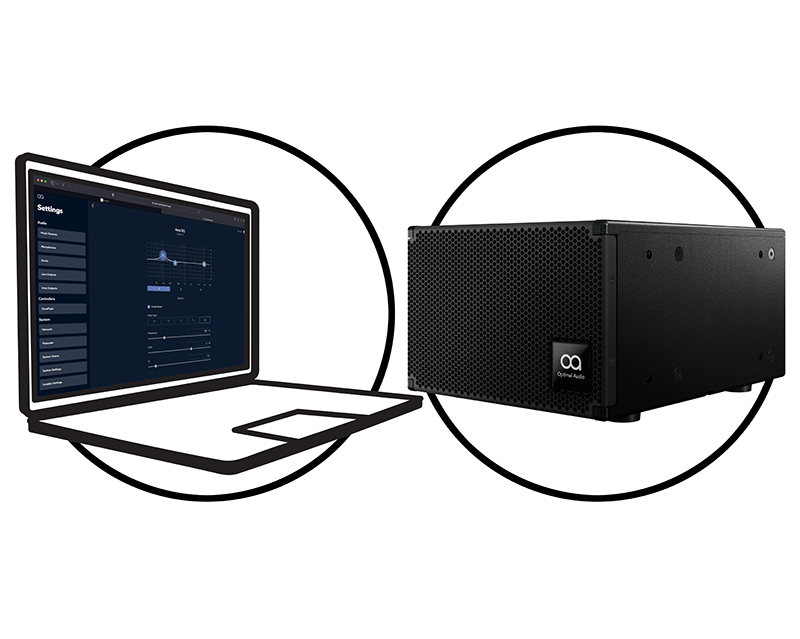
The compact Sub 6 is perfect for installations where space is at a premium. The unit can be placed in tight spaces such as under banquette seating, mounted on walls or ceilings, or flown using integral M8 inserts. Featuring a 6-inch driver with a generously sized low-frequency port to minimise air noise for a clean and powerful sound output, Sub 6 delivers 250W (AES) of power with a punchy peak SPL of 118dB.

Horizontal or vertical orientation is possible by way of low profile rubber feet which can be fitted on two surfaces, while installation is made as discreet as possible via recessed cable channels. An impact resistant perforated steel grille protects a durable MDF enclosure available in black or white textured paint.

With Optimal Audio SmartAmp providing amplification, EQ settings and limiters, the driver is fully protected when operating at higher sound levels. The unit can be driven by a pair of bridged channels on any powered Optimal Audio Zone controller, whilst the onboard WebApp ensures system setup and end-user control is straightforward.

Product Manager David Morbey comments:

“The addition of Sub 6 to the Optimal Audio ecosystem gives integrators yet more choice and flexibility in the commercial audio space, particularly benefiting smaller installs that still require greater low end punch. We look forward to welcoming customers for a first listen to Sub 6 at our next open days in September.”

The Optimal Audio ecosystem, complete with the new additions, can be explored at the company’s forthcoming Open Days which take place at its High Wycombe HQ on September 3rd, 4th and 5th. The events will provide the perfect opportunity for those passionate about commercial audio technology to learn, network and grow their knowledge while enjoying a comprehensive tour of Optimal Audio’s products. Optimal Audio training will also be offered to attendees who pre-register via the website.
For more information about Sub 6: https://optimal-audio.co.uk/products/loudspeakers/sub/sub-6/

For more information about Optimal Audio September Open Days: https://optimal-audio.co.uk/news-events/trade-shows-events/september2024opendays/

Click here for original article

Categories
Martin Audio

FOCUSRITE GROUP OPEN DAYS CONTINUE TO BUILD MOMENTUM

Martin Audio, with sister brands, Optimal Audio, TiMax, Linea Research and OutBoard, are joining forces once again for their successful Open Day programme over three days at their facility in High Wycombe.
Sessions run from September 3-5, from 9.30am-5.30pm on the Tuesday and Wednesday with a half-day programme on Thursday. All brands will feature with either audio demonstrations or presentations and as part of a series of educational modules.

Martin Audio will be running a separate point source demonstration, constant curvature and line array demonstration, as well as a stage monitor demonstration, and will also have in-depth training on DISPLAY 3 prediction software.

TiMax will showcase immersive audio solutions and will also be offering introductory software training, while Optimal Audio will be demonstrating multi-zone commercial audio as well as offering comprehensive training opportunities. Linea Researchwill be presenting an overview of their amplifiers and electronics as well as offering training on their System Engineer 8 control software. Finally, OutBoard will present an overview of their motor control and rigging solutions.

Free parking is on site and refreshments are served throughout the day.

There will also be plenty of opportunity to interact with staff and undertake tours of the factory, while refreshments will be available throughout the day and lunch is available on demand.

Visitors who have not already registered should do so without delay at:https://martin-audio.com/events/september2024opendays

Click here for original article.